
Cancer incidence in India has been steadily increasing over the past decade, now averaging 106 cases per 1 lakh people, as shown in recent data from the Ministry of Health and Family Welfare. While this rate remains lower than in most developed nations, the upward trend reflects significant lifestyle, environmental, and healthcare transitions within the country.
Comparison with Other Nations
In developed countries like the United States, UK, and Australia, the cancer incidence ranges from 250 to 300 cases per 1 lakh people. These nations record higher detection rates largely due to advanced screening programs, longer life expectancy, and better reporting systems. However, their mortality rates are lower because of early diagnosis and better treatment access.
In contrast, developing nations such as Bangladesh (90/1 lakh), Pakistan (94/1 lakh), and Nepal (86/1 lakh) report slightly lower or comparable incidence rates to India, though these figures may be underestimates due to limited cancer registries and diagnostic facilities.
India’s current position—between developing and developed nations—highlights a transitional phase where lifestyle changes and urbanization are increasing cancer risk, but early detection and treatment infrastructure are still catching up.
Regional Variation within India
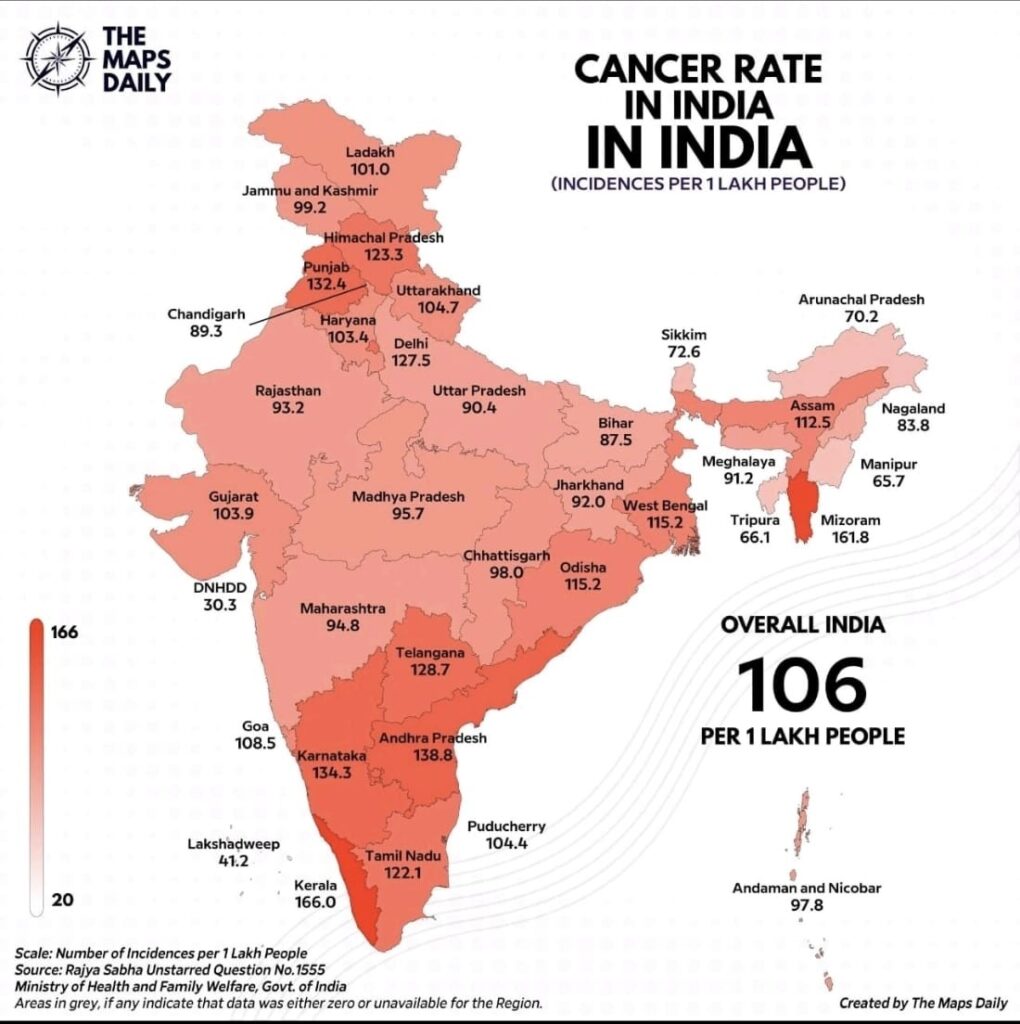
The map reveals striking inter-state differences:
- Kerala (166/1 lakh), Mizoram (161.8), and Karnataka (134.3) show the highest incidence rates, likely due to better cancer awareness and registry systems.
- Union Territories like DNHDD (30.3) and Lakshadweep (41.2) report the lowest rates, possibly reflecting under-diagnosis rather than genuinely low prevalence.
Key Reasons Behind the Rise in India
- Lifestyle and Dietary Changes:
Rapid urbanization has led to sedentary lifestyles, obesity, tobacco and alcohol use, and diets rich in processed foods—all major cancer risk factors. - Environmental Pollution:
Increasing air and water pollution, particularly in industrial and urban regions, contributes to lung, bladder, and gastrointestinal cancers. - Infectious Agents:
Persistent infections such as HPV, Hepatitis B and C, and H. pylori continue to drive cancers of the cervix, liver, and stomach in India. - Ageing Population:
As India’s life expectancy rises, age-related cancers like breast, prostate, and colon cancer are becoming more common. - Improved Detection and Reporting:
Enhanced cancer registries, better diagnostic tools, and public awareness campaigns have increased reporting, revealing previously hidden disease burdens. - Limited Preventive Screening:
Unlike developed nations, routine population-based screening for breast, cervical, and colorectal cancers remains inconsistent across much of India.
The Way Forward
Addressing India’s rising cancer burden requires a multi-pronged approach:
- Strengthening screening and early detection programs, especially in rural and semi-urban areas.
- Promoting public awareness about lifestyle modification and vaccination against preventable cancers.
- Expanding access to affordable treatment and establishing more regional cancer centers.
- Implementing stronger pollution control and food safety regulations.
Conclusion
India’s cancer burden is increasing, but it is not inevitable. With prevention, early detection, and strong public-health action, we can bend the curve. Each step—whether quitting tobacco, exercising regularly, or getting screened—brings us closer to a healthier, cancer-aware nation.
At Healius Cancer & Hematology Clinics, we are fully prepared to meet this growing challenge through state-of-the-art diagnostics, personalized treatment plans, advanced immunotherapy and targeted therapy options, and a multidisciplinary team approach—ensuring that every patient receives the best possible care, close to home.