

Why It Matters
- BSE is a monthly habit that promotes body awareness and confidence.
- It helps you recognize changes like lumps, dimpling, or nipple discharge early.
- Especially in settings where access to routine screening is limited, self-exams can serve as an important early alert to potential problems.
- Early detection greatly improves treatment outcomes — and can save lives.
When and How Often
Choose one day each month — ideally a few days after your menstrual period — when your breasts are least tender. If you no longer have periods, select the same date each month as a reminder.
Perform your exam in a well-lit room with a mirror, and then while lying down to feel all breast tissue thoroughly.
Step-by-Step: How to Perform Your Breast Self-Exam
Step 1: Visual Check (Look)
1. Visual inspection
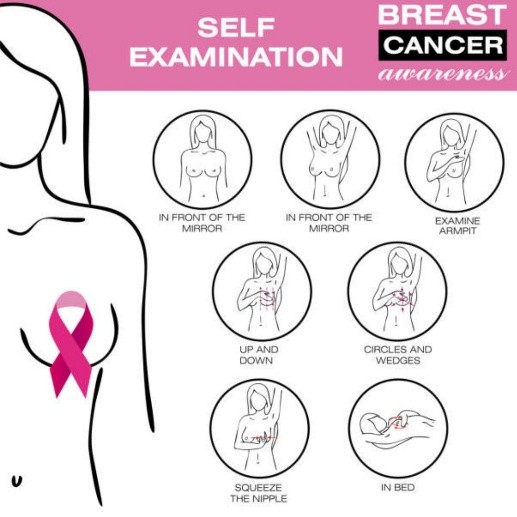
Stand undressed from the waist up in front of a mirror with your arms relaxed by your sides.
1: Keep your arms relaxed and look for any changes in size, shape, or contour of your breasts.
2: Place your hands on your hips and press inward, then turn slightly side-to-side. Observe any changes.
3: Raise both arms above your head and press your hands behind your head or on your hips; look again for differences between right and left.
4: Lean forward slightly with your hands on your hips — let your breasts fall forward. Observe if their shape or surface changes.
Look for:
- Changes in skin texture (e.g., puckering or “orange-peel” look)
- Redness, dimpling, or visible swelling
- Changes in the nipple (position, shape, inversion)
- Discharge (fluid/leaking) from the nipple or changes in the areola
2. Manual palpation (feeling with your fingers)
Step 2: Manual Check (Feel)
Lie down with a pillow under one shoulder. Use the pads of your three middle fingers on the opposite hand to examine that breast.
Move in small, circular motions — covering the entire breast from the collarbone to the under-breast fold and from the sternum to the armpit.
- Use light pressure for surface tissue
- Medium pressure for mid-depth
- Firm pressure for deeper tissue
Don’t forget to feel under the nipple and in the armpit area, where breast tissue extends.
Step 3: Nipple Check
Gently squeeze each nipple and check for any discharge. If you notice bloody, colored, or persistent discharge, contact your doctor.
Our Message from Healius
At Healius Cancer & Haematology Clinics, we emphasize prevention through education and empowerment.
This Breast Cancer Awareness Month, we encourage every woman to make self-examination a part of her routine — because knowing your normal is knowing your strength.
This Breast Cancer Awareness Month, Healius offers:
- Free breast checkups with Dr. Hemalatha Kalwad
- Complimentary genetic counselling if there is a family history of breast or ovarian cancer
Turn self-care into self-protection — your awareness can save your life.